James Beard Foundation: Celebrity Chef Tour

Let's be honest.

Dining at the James Beard house is a fantasy of mine. It's one of those once-in-a-lifetime experiences that sends my heart pitter-pattering. Followed closely by a terrifying thought, "What would I wear???" Someday, if the sun and moon are in alignment, I'll find a seat at the table.


Until then....

Fortunately for us, the James Beard Foundation is taking their show on the road! And they're coming to Seattle Thursday, May 14th.


Cooking high atop the Seattle skyline, overlooking jaw-dropping Puget Sound will be my old client, Chef Ethan Stowell. Yes, that would be the same Chef who was named one Food & Wine's "Top 1o New Chefs in America" and a two-time nominee for the James Beard Award. (Fingers crossed...maybe he'll win on Monday.)

Ethan will be cooking at the uber swank Columbia Tower Club with their Executive Chef James Hassell. For one night only, this private club will play host to the James Beard Foundation. And with sponsors including Wine & Spirits magazine, Certified Angus Beef, and Hudson Valley Foie Gras....rest assured...this will be a night to remember!


Highlights of the evening will include:

- An elegant reception, featuring unique hors d’oeuvres creations served with a complementary wine selection
- An innovative, one-of-a-kind multi-course dinner
- Wine pairings presented with each course
- Exclusive interactions with and access to the award-winning chefs
- Ability to see behind the scenes and experience the preparation of the courses


There are two ways to jump in on the fun:

To order tickets ($175 + tax and tip), contact Jeff Black at 720-201-1853 or jeff@innercirclecompanies.com.

OR.....

Drop me a line.


Yep! I've got TWO TICKETS available....gratis. (Hint: Tipping is nice...)


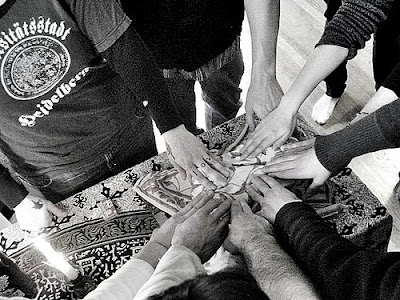
Here's how you can lay your hands on these tickets:

In the spirit of this post, leave me a comment...addressing the question: What does food mean to you?

Over the past few months, I've learned people approach their love of food from a number of different directions. Whether you lean towards ethnic food from the home country, molecular gastronomy with a twist of Americana, bon bons and brioche, or a beast over an open flame....

What is it about food that moves you...and what does that mean to you?

You've got until Wednesday May 5th to tell me all about it!

***
Note: If you're headed to Seattle for the International Food Blogger Conference, I hope you noticed this dinner is the night before the IFBC. You could....come to town a day early, dine & drink lavishly, and take time to enjoy the city before the conference kick in.

Sounds lovely, doesn't it?


The Interpretive Feast

Last fall I was introduced to Professor Britt Yamamoto, who teaches a master’s level class on the Politics of Food & Eating. Within seconds, I prodded him with questions about the class. "What topics are you covering? What's the required reading? How is the class structured?" He escaped my questions (read: interrogation) by sending me a copy of the syllabus.

Class readings probed serious issues surrounding agribusiness, sustainability, food sovereignty, biotechnology, and commodified food.

The class culminated with an assignment titled “The Interpretive Feast." Students were instructed to "explore your deeply embedded, largely unexamined personal eating narratives and recognize how these are linked to the broader social phenomena….Consider the broader scope of culture, history, politics, and economics.”

With that basis, students were asked to incorporate these ideas by preparing a dish that had meaning for them. This interactive assignment culled from a number of sources, including family traditions and favorite foods, using significance as a guideline.

I scored an invitation to the Interpretive Feast and on a drizzly morning, arrived at Professor Yamamoto's house. In the kitchen, a small group of students assembled their final preparations while I waited in the wings.

I've attempted to capture the experience in words at least a dozen times. Each attempt, my words ring more feeble than the first, but what I can say is that day had a profound impact on the way I look at food. I began to realize that every dish has meaning and it's as deeply personal as the person who prepared it. From the scones inspired by the mother-daughter tea in London, to authentic wild rice that still carries the scent of Minnesota lakes...and home, to the memories of family hunting camps and melt-in-your-mouth elk stew, food is a powerful thing. It ties us to the land and the people. It shapes our memories, provides comfort, and a link to our history. Food is so much more than mere consumption.

And then there's the story that moved me to tears. Fleeing Nazi occupation, a young Jewish girl abruptly left her homeland. She lost her siblings and all links to the past…except for her challah recipe. Over the course of her young life, every Friday she kneaded the dough. The recipe went hand in hand with the evening prayers, and this she knew by heart.


Flash forward 50+ years.

On a rain-soaked day in North Seattle, her granddaughter wove the pieces together with her own story. Her own life took a wayward path of rebellion and drugs, which had a powerful hold. An unexpected pregnancy proved to be a turning point. She kicked the drug habit and eventually made her way back to college. Along the way, she became curious about her heritage, and discovered her family’s Jewish traditions. The undercurrent of a rebel bubbles to the surface as she describes her faith--subscribing to those traditions that resonated and cast off those that didn’t. The challah became a powerful symbol…uniting these two women, present and past.

Every Friday, she makes challah for the Sabbath…with a recipe handed down from her grandmother. Today, her own daughter helps kneed the bread. Friends stop by and take a turn. From the traditions of the past, we erect our own traditions.


Blessing the bread


Flour, yeast and water symbolize so much more than their individual components. History, culture, faith, traditions…old and new, weave a web, uniting the past with the present.


Thanks to this experience, I’ve become much more reflective. Food isn’t just food anymore. I think about the stories, the traditions, and the people that had a hand in this food.

My everyday life is not always about the grass-fed beef raised on Tom Hartley’s farm, trimmed into steaks by an artisan butcher who has been working at the family business since he was 6 years old.

I recall my own family traditions…like tuna-noodle casserole, oozing with Velveeta cheese and crushed potato chips on top (the wavy kind, if we were lucky). This dish is a link to my own past, and present. As a kid, it was one of our most requested meals. But now, as an adult striving to be a more conscientious eater, I shudder to think how often I ate tuna noodle casserole…and the revolt that would follow if my mother used anything but Velveeta. (“Cheddar? How could you use cheddar?”)

Much to my grandmother’s distain, my mother was the first woman to hold a job in our family. She was the first to grapple with the precarious balancing act…juggling between the demands of work and family. Tuna noodle casserole was quick and easy. Mom could satisfy me, the youngest in the family, and still keep it hot while waiting for my brother to come home from football practice, or for my dad to drag himself home from a business trip. Thanks to tuna noodle casserole, we each enjoyed a hot meal…whenever we made our way to the table. And as I grew older, I learned, that’s no easy feat.

Each meal, we are presented with an opportunity for an interpretive feast. Whether you’re recalling traditions, or making new ones, think about it. This meal…what does it say about you?


Related Post:

I'd Like to Buy the World a Coke

Travel & Leisure: 50 Best New Restaurants in America

Fish Fry Restaurant, Seattle, WA
Photo credit: me!


This photo is significant for a number of reasons:

1. Fish Fry is my friend Michael Hebb's place.

2. The restaurant was opened as a front for Michael's notorious underground restaurants (think: modern-day speakeasy.)

3. The photo was taken on a camera...left in Michael's rental car, happily recovered, and mailed back to me.

4. I nearly deleted it.

5. And last but not least, this is my first nationally published photo! (Whoo hoo! I'm *still* doing the happy dance here!)


Looky here: "50 Best New Restaurants in America," Travel & Leisure, May 2009.

Food Prophet


Snapped at breakfast this morning....."Eat like you give a damn."


Amuse Bouche, the Beat of a Drum

On my way to a fabulous M.F.K. Fisher-inspired dinner, I found myself being led in the opposite direction.

In the heart of an affluent enclave...was that drumming I heard?

I followed the beats to a funky artist-run gallery. I've passed this spot a million times, later in the evening...long after they closed for business. More than once I've peered through the large windows, eyeing colorful Afro-Caribbean inspired art that filled the space in dreamy tropical colors.

On this evening, the door was cracked open and rows of folding chairs featured an audience...of exactly one. Opposite him was a character I can't even begin to describe:


A peek through the door resulted in an invitation to come listen.

I settled into a bench along the windows and noticed the musician played three djembe drums with intricately carved bases. Animal hides were stretched across each drum, and reverberated under a rhythmic blur of hands.

At times, the music seemed to flow through him, eliciting a meditative trance. As the beats grew louder, his head shook in a dance, urging nappy dreadlocks into motion. Only then did I realize his dreadlocks stretched to the floor.

After listening for several minutes, I thanked my host...and made my way to dinner.


Just down the street--yet worlds away--was a secluded private dining space, tucked behind a popular French bistro. I was led down a private walkway that spilled into a peaceful courtyard. This was the setting for an elegant dinner salon, dedicated to the readings of M.F.K. Fisher.

Inspired by her work, the dinner featured exquisite wines by Andrew Will and an unforgettable menu by Cremant chef Brendan Mcgill. Readings between courses served as a prelude to the chef's next creation. Candlelight flickered among the faces, and conversation flowed well into the night.

My favorite dish? I'm torn between:

Onglet "Rossini"
Grilled Hanging Tender with Cured Foie Gras and Truffled Pommes Puree

or

Ris de Veau, a la Union Station
Sweetbreads of Veal with Anise-Scented Veal Glace & Watercress Salad


For me, the enlightened evening of truffles & foie gras was was delightfully juxtaposed by the beat of an unforgettable amuse bouche.

Play on drummer man, play on.

M.F.K. would approve.

Alice Water's Food Fight


Alice Waters, the famed owner of Berkley's Chez Panisse is a powerhouse in the farm-to-table food movement. And lucky for us, she's in town...

Tonight Town Hall is screening "Food Fight: Revolution Never Tasted So Good". The film examines how American agricultural policy and food culture developed in the 20th century, and the California food movement launched the national trend towards local and organic.

Following the film, director Christopher Taylor and renowned chef and author Alice Waters will engage in a question and answer session. Light, local fare and libations will be served beginning at 6 pm.

Details:
Saturday, March 28, 20096
pm for food & drinks, film begins at 7 pm
FREE
RSVP Required: emeraldcityecofilmfest@gmail.com

Location: Town Hall, 8th & Senecahttp://www.townhallseattle.org/

Photographer Sam Abell on The Life of a Photograph

Long-time National Geographic photographer (1970-2001), Sam Abell is a legend in the photography world. This fall, he was in Seattle teaching a photography workshop at the Art Wolf Studio. I sat in on the corresponding lecture...and kicked myself for not attending his workshop! His lecture was incredibly inspiring and despite the blackend room, I managed to capture some legible notes.

As I develop my own technique, Sam's words echo in my mind. (Compose....and wait.....) Hopefully something here will resonate with you.


Sam Abell, Photographer
Henry Art Gallery, Seattle

Sam Abell’s work is complex, thoughtful, inspiring. He is considered one of the most articulate voices in media, with a knack for great story telling.

The hallmark of Abell’s work is its micro composition. His images are composed to the smallest detail, with an emphasis on expression, detail, and setting.

The photographer life is a well covered subject, and Sam Abell aks, ”What about the life of a photo?”

Photography is about thought. “The Life of a Photograph” is where it begins—in the mind, feeling, heart & soul in the one who holds the camera in their hands.


A bit about Sam

His dad taught him how to see. His mother taught him what to see.

What would you have been if you weren’t a photographer? A teacher. In his workshops, he teaches is the art of internal framing & micro composition.

When he started taking pictures, Popular Photography had thumbnails in the back that talked about how the photographer got the shot. He studied those.

“For me, photography was freeing. Thirty years at National Geographic allowed photography to take me into life.”


Equipment

“I use as little equipment as possible and a humble camera.”

His “walk around” lens is a 28mm, and the majority of his work is shot with it.

Abell doesn’t use flash—“You don’t need it.” In fact, he no longer carries a flash on assignment. Abell shoots with “borrowed light” because, as he says, it “casts a spell.”


The Scene

“Don’t look for subjects, look for the scene. What stops me is the scene.” Abell consuls, “Pay attention to your own internal aesthetic. Subjects don’t stop me, the scene does and that’s what differentiates me from my colleagues.”

In a steady and soothing voice he adds, “I think about the poetry of the scene—think about things in literary terms—light, color, heart and soul. Distil a scene or a moment. It can be charged with poetics.”

When capturing an image, “I’m thinking about what’s in the viewfinder and nothing else. You are in that little world and it’s deep…and complex.”


Thoughts on Post Production

With a hint of distain he says, “We’re in the golden age of post production.”

“Before post production, you couldn’t recompose the shot. It had to be fully finished. It couldn’t be rough and remixed. All the problems had to be solved in the viewfinder…and it gave photography intensity.”

Photography is and always will be a way to be in life. I got a 35mm as a graduation present. For me, photography meant “Andiamo!” – let’s go. It’s what gets me out the door.

When photography became computer-based, it became more about post production.

We’ve lost the spirit of being in life.


Leaving National Geographic

Abell spent 31 years as a photographer with National Geographic magazine. “I’ve always wanted my career to end with my call.” The moment came after a long, depressing year in Tokyo. Abell spent a year trying to get permission to meet with the Emperor of China. At last, he was granted a visit on the very last day. It was extremely frustrating.

When I finally got the meeting, the Emperor asked, “Are you satisfied?”

“I lied, ‘Yes, I am.’ "

When he returned from that shoot, he knew…it was time to end his career with National Geographic.


The Kremlin Shot

[This shot is one of Abell’s most famous photographs. In the lecture, he analyzed the shot and showed a number of frames taken before they settled on what has become an iconic photo.]

“This photo has long life.”

Noting several examples, he advises, “Keep taking photos—move around it. Change your position.”

This shot was taken on a day off. “But the truth in photographic life is, there are no days off.”


What gives life to a portrait?

For portraits, you have one camera. It means hanging out with people & occasionally taking pictures.

The rule of photos with people? Don’t take photos you wouldn’t take of yourself. Don’t prey on people. Build a rapport. Photography is an act of appreciation, not exploitation.

A successful portrait has three elements: setting, gesture & expression. They need equal weight and it’s almost impossible. You can’t pose a shot like that. The setting is important both in place…and light.

Look for: Gesture. Expression. Setting.

Do you need to see someone’s face to have a successful portrait? No. Hands are very expressive.

Portraits that have long lasting ability are within themselves and thoughtful--not obviously emotional.


Just looking….

A photo is like a short story where the page is about to be turned….

Photography is a solo journey. Involve your mind—verify a dedication to creating photography for the inner self. No art director. No picture editor. On your own. Your imagination. On assignment for as long as 14 months, you are alone with your thoughts.

Pay attention to what you’re looking at.

Just looking …intently. Notice the shadow. Notice that slender line that separates the horizon and the clothes line.

Just looking…at a shaft of light. Notice the painting situated both above and below the light.

Just looking…Notice the persistence of a strong horizontal line.


Getting the shot

Compose…and wait. Compose the place and wait for what occupies it. Be on a tripod, and be ready for the scene.

Look for integrity of line, space & depth. Everything is within its own space….exhibiting deep layers of time.

Bad weather makes great pictures. Compose & wait….

The photo with the longest life has emotional power. It stays in your memory…and leaves an impression. It has believability… suddenness…intimacy.


Travel Photos

There’s a long connection between photography and travel.

On a 15 week shoot in the Amazon, he didn’t take photos for the first couple days. He stayed with the aboriginals and built trust.

The result? His photos have texture and flow.

At one point, he begged the aboriginals to do a shoot in the morning or the early evening. But the hunt began at noon. The resulting photos? As the aboriginal hunters are coming home from the hunt with their kill, he used the long shadows as part of the shot.

In another example, land, sea, and sky have equal weight. What gives it life? The disappearance of the horizon.


Seeking the photo

The life of a photo begins with seeking the photo.

What stops him is often the horizontal line. He’s looking for layers, internal framing, and micro composition.

Compose & wait.

Always use a tripod. It makes a difference that adds to his composed style.

Depend on strength of the photo from the specialness of the light and the landscape that he sees.

Seek a characteristic horizontal line.

See the light, space, and graphics. Be attuned to the moment and craft in deep dimensional light.

The goal: A layered photo that is intense from top to bottom, front to back.


The life of a photo

Each photo has a life—thoughts and time evolve. He found images he didn’t even remember taking that he loves now.

Photos ask questions.

The main thing Sam looks for is layering and depth. Find a background, find a setting. Look for layers, deep composition, and micro composition.

Whether a photo is memorizeable or not, depends on whether it has a long life.


Comments

When looking at books by other photographer, he says, “I always look at the photo on the cover page.” Why? “The cover shot is almost without exception chosen by marketing.” The key: what’s the Table of Contents photo? [This photo choice gives more insight to the photographer’s own perspective (vs. marketing)]

Another interesting point Abell notes: In his own books, no photos are bled. None are cropped. And no photos go across the gutter.


The Book: Life of a Photograph

Abell’s latest book, The Life of a Photograph, covers his process….things that worked and why. It’s designed to be transparent: “The process [of getting the shot] is more important.” He draws a parallel, “Fixing the car is more fun than driving it.”

“Books have a great life. If anything has a greater life than a photo—it’s a book.” He adds, reflectively, “This book is my fullest expression.”

***

Further reading

Excellent write up on Sam's Master Photography Class.

Almost Spring


Looking for a quiet moment, I pointed my car East...and just kept going. A low bridge was slung over the creek, and I circled back to take in the view. Here, late season snow clings to the mountains, creating rivers of white among the Evergreens. And I was just in time for a seductive tango between afternoon shadows and the sun's deep golden glow.

The Muse

Snapped at The Muse Coffee Company, Seattle


Ipod, laptop, art and a fabulous cup of coffee, really, what more do you need?

Muse Coffee Company is fabulous spot in the Queen Anne neighborhood, owned by Brent Mart and designed by his wife Kelley L. Moore (Entertaining Editor at Seattle Magazine.)

I was first introduced to The Muse by fellow blogger, Keren Brown. Do you know Keren? She's a woman after my own heart, organizing blogger events at fabulous restaurants...and interviews with notable authors. On the day I snapped this picture, we'd just wrapped up a blogger interview with author Pamela Sheldon Johns, discussing her latest book 50 Great Appetizers.

Entertaining with Style: Simple Soirees by Peggy Knickerbocker


The perfect Sunday afternoon finds me surrounded by a bunker of books, plotting my next party. Truth be told, I love planning parties almost as much as I enjoy hosting them. And on the rare lazy evening at home, you’ll find me testing recipes…frequently making an entire meal out of appetizers.

Too often people avoid having dinner parties, and I think that’s a mistake. For me, dinner parties are the ultimate gesture in friendship. And I love nothing more than introducing my favorite people. When the light is low, and the wine is flowing, just before the main course is served….the evening hits a fever pitch. I sit back in delight, watching a myriad of conversations swirl around the table.

As I pack up boxes and transition to the next phase of my life, there are a handful of books I just can’t bear to be without. Peggy Knickerbocker’s book, Simple Soirees: Seasonal Menus for Sensational Dinner Parties ranks high on my list. As a former restaurateur and caterer with homes in Paris and San Francisco, Peggy knows a thing or two about entertaining.

Simple Soirees is designed to take the mystery out of parties. Organized with menu planning in mind, each section features approachable menus, with sidebars that draw on time management and decorating tips. Chocked full of photos, this book also provides a wealth of ideas. For serving: a well-worn cutting board doubles as a serving platter for cheese and a simple cake stands provides a perfect vessel for appetizers. Effortless decorating can be as easy as tree branches interspersed with heather & lemons, or a bounty of grapes clustered around candlesticks.

Forget the American notion that everything must be perfectly matched and designer chic. With a battery of mismatched plates and platters, Kickerbocker draws inspiration as the French do…with style and grace and a bit of history.

Entertaining can be a bit tricky, but Knickerbocker guides you effortlessly through the most challenging aspects. The chapter on Cocktail Parties & Benefits provides often overlooked tips that seasoned entertainers learn over time: benefits – as her mother used to say, “People want to know their donations are going to the cause and not the food being served.” Kickerbocker notes, “Colorful dishes tide people over and encourage them to dig deep in their pockets. “ Cocktail parties, on the other hand, “can be more lavish than a benefit, or give the appearance of extravagance. “ Easy, do head menus for both occasions follow advice on what to serve and how to stock the bar (“lots of ice, sparkling water, and one very good red and white wine….Keep it simple, guests do not need lots of beverage choice.”)

This is the book I wish I had years ago, and today, find myself reaching for over and over again. Armed with a cache of these simple, inspired menus—from Cracked Crab Sunday Lunch to Any Excuse for Pork, teamed with drool-worthy photos from Christopher Hirsheimer, before you know it, you’ll be sending out the invitations!


Sample Menu for Benefits

Assorted Nuts and Olives
***
Frittata of Chard with Melted Fontina
***
Basket stuffed with Seasonal Vegetables and Warm Bagna Cauda
***
Cecelia Chiang’s Minced Chicken in Lettuce Cups
***
Platter of Fresh Fruit and Cheeses
***
Parmesan-Pine Nut Crackers
***
Assortment of Cookies
***
Flourless Chocolate Nest Cake


Sample Menu for Cocktail Parties

Roasted Asparagus with Aioli
***
Crab Legs on Endive with Homemade Mayonnaise
***
Taramalata and Smoked Salmon Toasts
***
Cucumber Rounds with Smoked Trout and Horseradish Cream
***
Double-Decker Caviar Cake
***
Seed-and-Herb-Crusted Pork Tenderloin

25 Random Things

Floating around Facebook is a meme titled, "25 Random Things." In the getting-to-know-you department, it's a perfect fit.

When I finished my list, a few things became evident. I've currently got travel on the brain...where I've been (South Korea, Cuba and Thailand) and where I want to go... (Morocco? Ethiopia? or India?).

And this time of year, you can often find me hunkered under a lofty down comforter, curled up with a good book. When I finally gave it some thought, I realized...I read close to 1,200 pages a week[!]. No wonder my brain is on overload!

The rest? Straight up randomness.

Here goes:

1. I am a direct descendant of Henry Hudson, the English explorer who is credited for discovering Canada’s Hudson Bay and Hudson River. Guess you could say I've got explorer in my genes....


2. I like my travel long and slow. I’d rather play backgammon with little old men on the corner than visit museums or a beach.


3. To date, I’ve traveled in 17 countries and encountered hurricanes, military coups, and diving in shark infested waters.


4. I’ve had romantic interludes with a gold trader, a nuclear particle physicist, a shaman, a US Secret Service agent, and a modern day jaguar hunter.


5. I always thought I would learn to fly a plane, speak French, and play the guitar. Never say never.


6. I am a certified cold water scuba diver. I own a dry suit and have logged over 150 dives in the chilly Pacific waters. After a dive, my hands are so stiff I can’t get my gear off, which sucks because I usually have to go to the bathroom.


7. I want to experience Carnival in Rio, Trinidad and Venice. New Orleans? Been there. Done that. Got a truckload of beads to prove it!


8. I am in denial about my fear of heights, which makes for an extremely funny bungi jumping experience. The video? Hysterical!


9. I read everything I can get my hands on and often read several books at a time. On average, I cover about 1200 pages a week, plus audio books. I’m especially fond of non-fiction and cookbooks and I always make notes in my books. Always.


10. “No” and “It can’t be done” are my two favorite statements and I readily take on the challenge. If it makes sense, I’ll defy the odds and move heaven and earth to make sure it happens.


11. I write in a journal nearly every day…and never leave home without my camera. (I’d rather forget my wallet than be without my camera.)


12. I am on a quest for the ultimate molasses cookie recipe (moist & chewy with a big bold flavor).


13. I wish I was funny. While I love having serious and meaningful conversations, I wish I had the ability to make people laugh (especially myself).


14. I love chick flicks and old black & white movies—especially sentimental tear-jerkers.


15. When I was a kid, I told everyone I wanted to be a war correspondent—even though I had no concept of war. Today, I’m drawn to conflict-ridden countries and over the past year have been reading numerous books on geopolitics, microfinance, conflict resolution and photojournalism. (Emphasis on photojournalism here, here, here, and here.)


16. I prefer to speak with people, not to them. There’s a difference…and it matters.


17. I love the little moments....the way the light shines in shafts through the trees, racing towards the water to catch the last of a dying sunset, and the way he laughs heartily, with wrinkles that extend well-beyond his eyes.


18. The smell of hayacins and lilacs stop my dead in my tracks.


19. I was married in the penthouse of Seattle’s landmark building, the Smith Tower. (The triangle at the tippy top is a swank private residence, which used to house the building's boiler room. For a number of years, it was also the tallest building west of the Mississippi River.) While my husband and I are now divorced, I’m happy we still stay in touch.


20. Summer in Seattle? There is no better place.


21. My cat Jacques is not named after Jacques Pepin, but after Jacques Cousteau. In a strange coincidence, I also owned a cat named Calypso, which I later discovered is the name of Jacques Cousteau’s first boat.


22. I’ve been a horse nut my entire life and can identify nearly every breed. A childhood accident resulting in a broken vertebra put an end to an all-too-brief stint in show jumping.


23. I miss the easy going friendliness of the Midwest…where people make eye contact, smile at strangers, and say, "Thank you". This adjustment has been the hardest part about living in Seattle and I still haven’t overcome it.


24. While I am an avid baker, a brief stage at Bakery Nouveau put an end to any fantasies I had about being a professional baker.


25. My first trip to Seattle was for a blind date. I was living in Illinois at the time and flew out to meet a guy who worked at Microsoft. We dated for three years and I owe him an immeasurable debt of gratitude. He encouraged me to go back to school, travel internationally, and although I was a reluctant student, he patiently taught me how to use a computer. We had numerous discussions about authors, government and foreign affairs. In the end, he was looking for a place to stand, and I wanted to fly. Graciously, he gave me wings.

Blue

Snapped at Stumptown Coffee Roasters, Seattle


This photo love is in lieu of an honest-to-goodness post. There's a flurry of activity on my end and I can barely catch my breath. Hang tight. I'll be back soon....

In the meantime, take a good look at this photo. I love the way the blue in her boots is echoed in the book on the table. And notice the play between grey on black? The more I look, the more I see....

Headcam? No, it's Twitter

More than once I've been told "I wish you wore a headcam! I'd love to follow you around!"

Looking back over my calendar, I can see why.

This past year was jam-packed with author visits, interviews, parties, and more tasting events than I can shake a stick at. Honestly? It's not uncommon for me to attend up to 10 events a week and trust me, at that pace, lots of good stuff slips through the cracks. (One day we'll have a lil' chat about Blogger Guilt...)

But in lieu of a headcam, I'm now on Twitter.

This is the place to see what the heck I'm up to when I don't have time to write...Expect a little of this-and-that and take heed: you'll soon discover I read A LOT. My Twitter updates include a hodge podge of favorite books, articles, chefs, photographers, documentaries, local happenings....and whatever else trips my fancy.

You can find me here:
SeattleTallPopp


Hope...with artist Shepard Fairey


No doubt this image of then Presidential candidate Barack Obama will go down in history as a deeply symbolic image. Designed by street-turned-graphic artist Shepard Fairey, the image was donated to the Obama campaign.

While marketers and historians will spend years analyzing Obama's campaign, adaptation of this image marks a definitive tipping point.

Here, Fairey discusses the impetus behind the image...and how it has evolved since the inception. It's a fascinating piece that has lingered long in my mind.

If this isn't nice, what is?


Blueberry lemonade, Volunteer Park Cafe (Seattle)


Excerpt from Kurt Vonnegut's commencement speech, Rice University, 1998:

...every graduation address I've delivered has ended, and this one will, too, with old stuff about my Uncle Alex, my father's kid brother. A Harvard graduate, Alex Vonnegut was locally useful in Indianapolis as an honest insurance agent. He was also well-read and wise.

One thing which Uncle Alex found objectionable about human beings was that they seldom took time out to notice when they were happy. He himself did his best to acknowledge it when times were sweet. We could be drinking lemonade in the shade of an apple tree in the summertime, and he would interrupt the conversation to say, "If this isn't nice, what is?"

So, I hope that you Adams and Eves in front of me will do the same for the rest of your lives. When things are going sweetly and peacefully, please pause a moment, and then say out loud: ''If this isn't nice, what is?''


Seattle Food Writer Round Up

Seattle has cultivated a number of serious food writers....and if you've been following Gluten-Free Girl, Orangette, or Roots and Grubs, here's an event you won't want to miss.

Hope to see you there!

I'd like to buy the world a Coke


2008 was packed with monumental moments....but for me, the most significant highlight was being invited to speak at Antioch University.

Last fall, Antioch's Center for Creative Change offered a master's level class titled, the Political Ecology of Food & Eating. Through a variety of channels (readings, videos, and an "interpretive feast"), students examined the impact food choices have on natural systems, cultural practices, and political economic structures. Topics ranged from food production, distribution and consumption and the effects they have not only nationally and internationally, but also on the human body.

Seattle PI journalist and James Beard Award-winner, Rebekah Denn and I were asked to address a number of points, but I found myself mulling over one question in particular: "What brought you to this point where food and eating is so integral to your career, life and passion?"

This Coca-Cola commercial represents a significant early influence.

As a kid growing up in the '70s, my mother had just entered the job market. Babysitters took the form of TV, and my brother and I watched endless hours of television. I was raised in Peoria, Illinois--a sleepy Midwestern town bordered by the Illinois River, with corn fields and soybean crops as far as the eye could see. Bombarded by commericals and middle-American values, Coca-Cola was the "everyman" indulgence...and we consumed it by the case.

During those countless hours of television, this commercial played repeatedly. My girlfriends and I would roller skate in front of the house--decked out in Princess Leigh braids and tube socks, singing the Coca-Cola jingle over and over again.

"I'd like to buy the world a home...and furnish it with love.
Grow apple trees and honey bees...and snow white turtle doves.

I'd like to teach the world to sing in perfect harmony.
I'd like to buy the world a Coke, and keep it company. "


Then, I was infatuated with pre-teen love and a romantic notion idealized by apple trees, honey bees, and turtle doves. And maybe some small part of me believed it could be obtained through a bottle of Coca-Cola. Advertising is powerful.

But it is the visual image that lives with me today. Picture a diverse group of people, gathering together over the slightest common unifier.

What else do they have in common?

We're not sure yet.

Let's bring them to the mountain top and find out.

In this example, the opportunity began with something as simple as a Coke. What about our world today? Where does the dialog begin?

My career has come to signify many things...but ultimately, you could say: I proactively seek opportunities to bring relevant people around the table. And food is the catalyst. It is the reason we come together, but is far from the final outcome.


Flash forward to today.....

Until recently, my eating habits were highly influenced by advertising. Thanks to early imprinting from my childhood...food meant more than fuel to nourish the body. Food was comfort--a substitute for nurturing...and it came in the form of industrialized products and fast foods, American-style.

When I moved to Seattle, a whole new world opened up. Local, seasonal and organic are so embedded in our society, it's almost passe. Then I took a hard look at my eating choices...and Coca-Cola was the first thing to go.

I became serious about food and it manifested itself in a number of ways. Over the years, I've worked with chefs and farmers, politicians, journalists, fishermen, chocolatiers, food writers, photographers, bloggers, and foragers. Their passions became an extension of my own...and I began to realize, directly or indirectly, we all have an impact each other.

Apple trees. Honey bees. Snow white turtle doves.

My mind kept reverting back to that commercial. A hilltop in Italy, drawing people from diverse backgrounds.

What if....

What if....we identified the common bond among leaders in their field...and extended an invitation to the table? What if...we provided a forum for meaningful dialog? What if...a meal...was the catalyst that finally brought us together?

An idea was born.

My background is extremely varied, but all roads came back to food. Whether I was working for the House of Representatives, a non-governmental organization, or one of the top brokerage firms in the country, food was my "true north." For staffers or brokers, interns or elected officials, a plate of brownies or a pint of homemade ice cream greased the skids and bonded us together on more than one occasion.

Food fueled my passions.

Today, I take every opportunity to draw people together--whether it's dinner for 20 in back room prep kitchen, Chinatown Grub Crawls, or a series of tastings in the cupping room.

I have a dream....that as food & travel lovers who are curious about the world, that's all the bond we need. United together over a hilltop in Italy, or the brotherhood of bacon, you have something to share...and we have something to learn. If I can provide that connection...and tip the balance, for me...there is no greater joy.

Blue Moon

Back of the delivery truck. [Spotted on my way to lunch with New York Times columnist & author Mark Bittman.]

A Chat with Iron Chef Challenger Sabrina Tinsley

Pietro Borghesi (co-owner) and Sabrina Tinsley (chef and co-owner) of La Spiga, Seattle, WA


Chef Sabrina Tinsley was recently featured on the Food Network's Iron Chef Challenge and I had the opportunity to speak with Sabrina about her experience. We discussed everything from culinary influences to regional Italian cooking, and of course...got some scoop on what it's like to compete against the Iron Chef!


Traca Savadogo: How long have you been cooking? What started your journey into food?

Sabrina Tinsley: I grew up around food. My mom was always cooking and trying new things—very exotic things, not necessarily traditional American. But she would go around the world with her cooking. We had a huge garden growing up, so she would obviously cook from the garden. We were in Alaska, by the way, up in Fairbanks. It was a nice growing season because of the light all night long [i.e. this is the land of the summer midnight sun] and she would cook out of the garden. We had these huge zucchinis and would have to figure out ways to use it. So we got very nice, well-rounded hands on point of view of food. We had small livestock as well, so we were introduced to butchering at a young age.

I didn’t realize I had such a passion for food though until I left home and went off to college. I started experimenting myself with cooking and realized what a wonderful thing it is to manipulate the food to taste the way you wanted it to taste—like EXACTLY the way you wanted it to taste, or EXACTLY the way you remembered it. So I just went from there.

I didn’t go to formal cooking school, but I ended up going to Europe. That was my dream—to travel, and Europe was certainly a destination. So I went to college in France and I experienced French food first hand, and then I landed a job in Austria. I lived there for a year, so I experienced that cuisine and moved down to Italy after a year because I’d met my husband…or my husband-to-be, at that point. We met in Salzburg in a café and after a year of back and forth, I moved down to Italy. So then I was in Italy for five years and that’s where I picked up the Italian, obviously.

My husband had a job that took him all over Italy, so I would get to travel along with him. I got to experience quite a bit of the country and I just understood how diverse Italy is from region to region—and even within a 20 mile radius, it changes—the dialect, the food, the culture. Everything changes so drastically.


Traca: The style that you’re cooking now, what region is that from?

Sabrina: Emilia-Romagna.


Traca: What made you focus on that particular region out of all the different styles that are represented in Italy?

Sabrina: Well, that’s where Pietro [her husband] is from. We’re kind of on a mission here because Emilia-Romagna is a huge tourist area, but not necessarily for Americans. We want to put Emilia-Romagna on the map. People know products from that area…they know prosciutto, they know balsamic, they know parmagiano, they know tortellini. They know all these things, but they don’t realize that it’s from Emilia-Romagna. Casual tourists don’t visit that area too often.


Traca: Really? Why do you think that is?

Sabrina: They know Venice, Rome, Naples, Milan—the big cities, which also have their own culture but they don’t have piadina, for example. And piadina is a big thing for us.


Traca: What is piadina? Can you describe it?

Sabrina: It’s a flat bread and it’s grilled instead of baked. It’s considered the food of the Emilia-Romagna people and it was once considered poor man’s food because it was all that they could really put together as far as bread.

They didn’t have formal flours, so they couldn’t make a leavened bread—that was saved for the rich people. They would end up making piadina from whatever they had. That would be fava meal, chickpea meal, cornmeal…anything that was considered a poor man’s food. I’ve even read accounts where they’ve used saw dust, because that’s all they had during that time period.

Originally piadina was something they were kind of ashamed of, but after the War, the ladies started setting up their little shops where they would make it on the street and start selling it. And people got over that feeling that it was a ‘poor man’s food’ and started to be really proud of it.

Now, there are piadina shops on every corner. Every Romagnolian has their favorite shop that they go to. Some people make it in the home, but it’s so easy to get and it’s so inexpensive that they generally just go buy it because it’s a lot easier.


Traca: Is it topped with anything?

Sabrina: Oh yeah! They make sandwiches out of it. It depends on what your purpose is. You can buy piadina plain…in which case you’ll take them home in the whole round disc, or cut in half. They’re generally cut in half. Or they’ll make a sandwich out of it and you’ll eat that as your lunch or midday snack or as your dinner.

They also make crescione [creh-show-neh]. It’s the same dough as the piadina, but they fill it before they cook it, so it’s like a little pocket—like a little hot pocket. They make all different variations of crescione. It’s very filling, so generally if you have one of those, you don’t eat lunch too. During the market, they’re open early in the morning. It’s a very traditional bread.

We had a shop in Italy where we were selling piadina, but it was outside the piadina region…a little bit further south. We also had a frozen yogurt shop. We opened up a piadina shop and it did very well. People loved the bread.

We came over to Seattle because we were ready for a move. We had the businesses for almost five years and we were ready for a change. Either we were going to continue with piadina and move down to Rome and set up a chain of piadina shops, or come to Seattle and open up a restaurant.


Traca: What brought you to Seattle?

Sabrina: My sister had been living here for about 12 years at the time and we had come to visit a couple times and we loved the area. We thought the Seattle public was open-minded enough to be able to accept something a little bit different--not the Italian-American cuisine that’s so commonly found but a real, authentic thing…and piadina. Our original concept was based primarily on piadina.


Traca: Are you still doing piadina?

Sabrina: Oh yeah, we still do piadina! We used to have about 30 [piadina] sandwiches on the menu, and now we have one [it’s topped with roasted wild boar, caramelized shallots, taleggio].


Traca: So the menu has changed…what’s the focus now?

Sabrina: Now we do homemade pasta. People were requesting pasta, pasta, pasta and we were planning on making pasta, but we thought it was going to happen later on in the process. Originally we were going to wait a couple years and start making homemade pastas, but with the demand, we ended up bringing it in 4 or 5 months after we opened. We’ve been opened for 10 years now.


Traca: When you import a cuisine, critics cry out...”It’s not authentic.” Are you having any issues sourcing ingredients to replicate foods from the home country?

Sabrina: I had to make some adjustments. We use whole foods and raw ingredients for most of our cooking, so that’s not an issue because I know what the food it supposed to taste like. If I need to alter [a recipe] somehow, I pretty much know what I need to do to change it.

I’ve noticed, for example, that celery here in the States is a lot stronger than celery in Italy. Garlic…I noticed it was a little bit stronger there…and the variety they have is more flavorful.

We had minor adjustments to make—a little bit less of one product or a bit more of the other. For example, in my sauce, I use a combination of fresh and canned tomatoes to achieve the same flavor that I got in Italy. It’s just a matter of tweaking things.

As far as cured meat, for example, we can always get prosciutto so that’s not an issue. The most difficult thing for us to find is salami. They can’t import it. Only recently have we found a really nice salami that’s very traditional…and it’s in fact, made by an Italian. It’s Creminelli Brothers. I don’t know if you’ve heard of it. But it’s really nice. The one that we’re getting -- Felino is really soft like it’s supposed to be, not super aged. Sometimes they want to speed up the air dry process—or it always seems like they do—by either putting heat on it or airing it so that the salami often has a very inconsistent aging process. It will be really hard and tough around the outside and a lot softer in the middle. But this new vendor we found, theirs is very soft—the way it’s supposed to be.


Traca: As far as finding your ingredients, are you working with the local farmers? Are they growing anything specific for you?

Sabrina: I’m going in that direction. It’s been a challenge for me especially with the move [to their new restaurant location, which is in a much bigger space].

I’m definitely going in that direction and I have a few sources. We have the opportunity to have Willy Greens grow whatever we want on a plot of land on their property. And we have some very specific ideas of products we can’t get here, but I may have to provide the seed. I have some of the seeds, but we’re working on that.

We buy organic whenever we can and even our meats…through our purveyors, I don’t work directly with the farmers themselves, but though our purveyors, I try to buy hormone-free, antibiotic-free meat, and humanely raised.


Traca: Are there any changes you had to make to cook for the American public? Are there any dishes that wouldn’t fly here in the US?

Sabrina: No, not really. They’re real minor things. For example, the piadina. When you got to Italy and you buy a filled piadina, you get a whole round disc that’s cut in half and then filled. Here we do half a disc, that we slice in half horizontally because our piadina is on the thicker end. Even that ranges in thickness, depending on where you are in Italy. It’s a lot thinner the further south in Romania that you go. We slice it in half horizontally so it’s not so much bread, and it’s not so filling because we wanted people to try a couple different thing—not just the piadina. This way, it’s served more as an appetizer than an actual meal. Other than that, we haven’t made any changes.

Customers [acclimated to the more familiar American-Italian restaurants] will comment, “Why don’t you get real bread?” And in the beginning, customers would comment that the portions were small. We were serving an Italian-sized portion, not an American-sized portion. People would ask for chicken alfredo or shrimp alfredo…or spaghetti and meatballs, that’s not traditional.

But we’ve held strong and I think people that really understand the Italian culture appreciate that.


Traca: Can you tell me about your influences? You mentioned your mother….It sounds like she was cooking during the Julia Child era.

Sabrina: My whole family on my mother’s side is really into food. Her grandmother did cooking in Canada so my mother would go stay with her every summer on her farm. They would cook meals for couples that were stopping along the road. They would come in and my mom would help prepare the food. My great aunt--my great grandmother’s daughter, she had a catering business and cooked for a family. That was a big influence as well.


Traca: What cookbooks were you influenced by?

Sabrina: I started cooking out of the Moosewood Cookbook and Silver Palate, and there was a book that was given to me when I graduated from high school and it was from a dear friend of my mother’s…it was a catering book called Glorious Food. It’s a catering company out of New York.

You know when I look back on it now, I’m so impressed how well-researched [Glorious Food] was. It was always very authentic no matter what culture they were cooking from. They always presented a very authentic version of it. That was huge for me. I read that book cover to cover, probably a million times.

And then there was a bread book that I cooked a lot out of. I cooked a lot of breads. My mom cooked a lot of breads.

I also did a bed and breakfast during my college years. We had a vacant house in Alaska, so I would go up and provided a bed and breakfast there during the summer. I did a lot of cooking during that time. The bread book was very handy because I made breads for breakfast. And the Cake Bible, that’s another great book.


Traca: What books are you reading right now?

Sabrina: Not a whole lot, it’s been pretty busy. I’m trying to think about what I want to get my hands on though…I don’t even know. It’s been a long time. I just finally finished Fast Food Nation, which took me a while to get through.

I’m into learning about the health aspects of food, for sure. I’m thinking about what kinds of poisons we’re putting into our bodies on a daily basis. There’s only one pure way of cooking and it’s actually very dangerous for a restaurant, which is [cooking with] glass. Because everything else…all the metals impart some kind of poison or other into the food. So I’m really researching that, and I’m researching ways to keep our food as chemical-free as possible. I’m pretty successful at home with the kids—I have two kids, but it’s really difficult. So that’s the direction that I’m going right now and the things that I’m researching.


Traca: What inspires you? Do you draw inspiration from other chefs...other cuisines?

Sabrina: All the above. I think the biggest inspiration comes from when I’m actually eating food. When I’m eating, it recalls memories or it brings about ideas. Whenever I’m out to eat, I’m always observing and if I’m not able to try something on a menu, it still sparks an idea or a memory about something I may have had in Italy.


Traca: Do you keep a food journal? Or how do you capture all those ideas?

Sabrina: I don’t. It’s all in my head! And it’s funny because even recipes and so on…often times cooks in my kitchen will ask where a recipe is and I’m like, “It’s in my head. I can show you how to make it.” I think that it’s interesting that you ask that as well because I do have a journal and recently I’ve had this urge to keep it up and start getting everything down. It’s not just food related, but everything that goes on in my life.


Traca: I journal too. For me, it seems to help balance things out. So, do you have any guilty food pleasures?

Sabrina: People always laugh at me when I say this, but I know that it’s completely wrong…even though it’s not 100% unhealthy, but I love strawberries in the winter time.

I’m not into junk food…at all. I grew up with a dad that was very conscious about health—he’s a physician and has seen what the results of smoking, drinking…even sugar was a big thing for him. Don’t eat too much sugar. Even though I was rebelling at a certain point and eating all the sweets I could, at this point in my life, I tend to eat what makes me feel good, so I have a good association with healthy food. I don’t indulge too often. I just feel bad afterwards. I feel horrible. My body feels horrible. So that’s my guilty pleasure.


Traca: Are you finding flavorful strawberries in the winter?

Sabrina: No, that’s the problem! That’s the crazy thing. I use them as a fruit in my cereal or whatever. It’s more of a food enhancer. That’s the point, to get that little fruity tartness that I feel goes really well with those things. (We’re cracking up here…)

If this helps at all, I love fatty meat like oxtail, but I really only indulge in that once in a while. We have that on the menu now. And we’re doing a pork belly confit that’s absolutely out of this world, but I can’t eat that much of it because it just doesn’t make me feel good. Yeah, I do like the fatty meats. Absolutely.


Traca: Let’s talk about Iron Chef. How did that come about?

Sabrina: Wow. It was just a call out of the blue. After I got the call and started watching the program. I heard about some chefs that were competing in an Iron Chef competition to be able to get to the show, or maybe they worked with one of the former Iron Chefs at another restaurant. That’s why, to me, it was so out of the blue because I thought that could never happen…or happen to me. I never applied or tried to get onto that show. Though Iron Chef…the Japanese version was one of my favorite shows of all time, I’d never really watched the American version. It was definitely a call out of the blue.


Traca: So how did they find out about you? Any ideas?

Sabrina: Yeah, I asked them that. They said they read an article in either the Seattle Times or the Seattle Weekly and I guess they just did their research from there. Mario Bartoli knows of us because when he came to Seattle, he did one of his episodes at La Spiga [her restaurant]. You never know how they actually hear about you. Maybe I just fit the profile…a woman in Seattle.


Traca: The show is airing this weekend, but when was it filmed? Sometimes it can take a while to get on the air.

Sabrina: It was in June. Last year, mid June.


Traca: That’s exactly what happened when we filmed the "No Reservations" episode with Tony Bourdain. We shot it in June and it aired in mid January. It takes a while. I’m curious about the rules for Iron Chef. What were the parameters and how many people did you bring?

Sabrina: We brought two people.


Traca: That’s a tough choice. Who did you bring…and who did you leave behind? I’m sure you had to leave somebody talented behind to run the restaurant.

Sabrina: It was a tough choice. I took Jon Langley, and Jeff Konkle. Jon is my sous chef, so that was an obvious choice. And then Tony Mueller was left behind in the kitchen. He was our senior line cook at the time. He was a little nervous about us being gone at that time, but he did well. It was only 3 or 4 days.


Traca: So you flew out to New York and the next day you shoot? Or how did that work out? What was the timeline?

Sabrina: We intentionally got out there pretty early—2 or 3 days ahead of time, so we could adjust to the time change (3 hours behind us in Seattle) and to get into the mode. We went to a viewing of Iron Chef the day before our battle, which is a requirement. That was actually the first day of filming. We shot the second day of filming, so it was helpful that I had a chance to see how the battles take place.


Traca: Watching a taping of Iorn Chef was a requirement?

Sabrina: Yes. They want you to see a battle beforehand.


Traca: Once the cameras are on, you really only have an hour, is that right?

Sabrina: It’s only an hour.


Traca: I talked with Tom Douglas [another Iron Chef competitor from Seattle] and he mentioned that it took a long time for the battle to get started, but once it began, you really only have an hour to get it all together. Was that your experience?

Sabrina: They kept mentioning that we were moving along pretty quickly. It took a while, but I was very into the moment, it didn’t bother me at all. We didn’t have that many takes and moved along pretty quickly.


Traca: What do you mean by “first takes”? What did they cut into takes?

Sabrina: It was for the beginning part…where there’s a lot of smoke and the Iron Chef comes from behind. The smoke has to be just right. They assured me it was okay to be inhaling all that smoke, but I breathed in a lot of that. We had to get it just right and there were a number of takes for that. But as far as me interacting with Mark (The Chairman), that went pretty smoothly and pretty quickly.


Traca: Did you have any idea about the secret ingredient…or what the range of ingredients could be? How do you prepare for Iron Chef?

Sabrina: Well, there are strategies…but I’ll decline to say what they are because it could ruin watching some aspects of the show. But there are strategies, for sure.


Traca: Are you able to request certain ingredients be available or can you bring your own?

Sabrina: You are allowed to request ingredients…a few things. If you’re used to working with a certain type of olive oil or you definitely want to try to include a certain ingredient, than you can request that.

Generally, you’re not supposed to bring anything in unless they absolutely cannot find it. They will source your ingredients, so there’s a lot of work behind it. You know the ingredients and what equipment is available.


Traca: Working in an unfamiliar space is tough and it’s nice to have things that you’re familiar with. Were you able to bring anything besides knives?

Sabrina: If we needed a special piece of equipment, we could bring it. We just had to have it approved ahead of time.


Traca: Alton Brown seems to get really excited about the ice cream machine. Did you use the ice cream maker?

Sabrina: No. No, we didn’t.


Traca: There are some heavy hitters associated with the Iron Chef. Is there anybody in particular that you were looking forward to meeting? What was that like?

Sabrina: Yeah, I’m a really big fan of Alton Brown. I watch Good Eats all the time, so I was really looking forward to meeting him. I was curious about meeting Mark, the Chairman. And I was really happy to have met Bobby Flay.

It’s no secret at this point who I battled. Bobby is awesome…and a very nice person. He gave me his contact information and said, "If you ever need anything, call me…" -- that kind of thing. We had a nice conversation off camera. I was really happy to have met him.


Traca: I’m glad to hear you say that because a lot of chefs hate Bobby Flay for some reason.

Sabrina: I know!


Traca: On camera, Bobby Flay comes across as smug.

Sabrina: To him, Iron Chef is a job and he does more shows than any of the other guys. And it’s taxing to him. I mean, he gets just as nervous about the battles as everyone else. He wants to do a good job….and it’s not just a given that he wins. He could very easily loose and it’s not necessarily a good thing for his reputation to loose either. It was interesting to hear that perspective and see how real of a person he really is. He was going to Italy after he was done taping the season and we talked about that a little bit..It was really nice.


Traca: So how was Alton? Is there anything that struck you about Alton Brown?

Sabrina: No, I wish I had more opportunity to talk with him. He was concentrating and focusing on what he had to do. Off camera, he was preparing for the shoot, focusing on what he was going to say.

It would have been nice to talk with him as well. I have always a million science questions to be answered and it would be exciting for me to have time with someone who cooks from a scientific point of view to be able to bounce ideas off of.


Traca: I won’t ask you want the secret ingredient was, but sometimes when you watch the show, it’s a really obvious ingredient…like parmesan. And then I talked with another Iron Chef competitor and she got crawfish. Until the Iron Chef battle, she’d never cooked crawfish before!

Sabrina: That’s funny because I always figured they chose an ingredient that they knew the challenger was familiar with. Because Tom Douglas got salmon.


Traca: I know, it’s crazy. So you got an ingredient you were familiar with?

Sabrina: Yes.


Traca: So how was the judging? Did you get any sense of home team bias?

Sabrina: No. It was interesting to hear Jeffrey Steingarten’s reaction to my dishes because a lot of the criticisms that he usually gives, they didn’t even get mentioned. It was interesting to hear his thoughts. And then one of the judges was a vegetarian, so that was interesting.

Joe Bastianich was also a judge, who is Lydia’s son. He was by far the most objective for the type of cooking that I was doing. And it was refreshing to hear some of his comments. He understood where I was going with everything, so that was really nice. He also invited us out to lunch afterwards and there were 10 of us that went over to his restaurant.


Traca: What’s Joe Bastianich's restaurant?

Sabrina: Del Posto, he owns it with Mario Bartoli. It was so good! We just let them choose everything. There were lots of small plates and appetizers. Amazing food.


Traca: So what’s the next step? What’s on the horizon for you?

Sabrina: As far as immediate things for La Spiga, we’re looking into doing a kids menu. My daughter, who is 7 years old, has been pushing for the kids menu for 2 or 3 years now. She’s on the computer and she’ll type out what she’ll put on the menu…and then she’ll draw pictures. We have a whole portfolio of pictures that we can make a coloring book out of. We’re inventing kids drinks now. We’ve got the Mickey, which is fun. The Mickey is orange juice, sprite and a splash of cherry juice with a cherry. And we’re in the process of inventing the Mini for Martina. So we’ll have a drink list for kids to kind of give parents a reason to come enjoy the food and make it fun for kids. Hopefully it will be educational. Mini has a character called the Piadina Man. People know piadina through La Spiga here, but it’s nice to kind of reinforce that.

We’re also going to put together an internship program this year, where we’ll have four interns per year for a 3 month program. At the end of the year, we’ll choose one of those interns to go over to Italy to further their internship. Included in that trip to Italy will be a staff member from here as well—someone who is going to be with us for a while, obviously, and who we feel deserves to the trip and who we want to learn more about Italy. So that’s in the works.

Pietro [ Sabrina’s husband and partner in La Spiga] is looking at doing tours over in Italy. They’re looking at May for a tour. He and one of our friends, GianPietro Ottolini, who is a wine importer who used to work for Elliot Bay [restaurant]. They are putting a tour together for a trip to Emilia-Romagna.

These are all things to reinforce our concept and to educate as much as possible about that area—about Italy in general, but also about Emilia Romania and to always improve. We’re always looking to improve. We never relax as far as that’s concerned.

One more project that we’re working on is our loft space that we have next door (corner of Pike and 12th). We do private dinners there and cooking classes.


Traca: You do cooking classes at La Spiga?

Sabrina: We’ve always done them—even at our old location. Here it has been a lot more challenging because there’s always someone in the kitchen. With the loft space, we’ll be able to do the cooking classes. We already have 1 cooking class scheduled per month for the whole year. And that particular series is the pasta and wine series. We’ll teach a type of pasta, make a sauce, and taste wine.


Traca: That’s awesome! How do I find out more about that?

Sabrina: It will be on our website.


Traca: You’ve got some great things going.

Sabrina: It’s going to be a full year!


Traca: I’m thinking you have a cookbook on the horizon too. (She said, hopefully!)

Sabrina: That’s been in the back of our minds, absolutely.

***

La Spiga
1429 12th Avenue
Seattle, WA 98122-3905
(206) 323-8881
www.laspiga.com

6 Great Discoveries in the Web World

Over the past few weeks, I've been discovering a slew of good stuff on the web. And in the interest of sharing...I'll show you mine...if you show me yours!

Got a favorite website...culinary or otherwise? I'd love to hear about it.

TED: Ideas Worth Spreading - The best and the brightest are represented here...including a number of people influencing the culinary landscape in America: Michael Pollan, Mark Bittman, and Dan Barber...just to name a few. And if you're looking for a little inspiration, don't miss Bono's Call to Action. Andrew, I'm hopelessly adsicted to TED. Thank you!

Eric Ripert - Extraordinary chef of Le Bernardin restaurant and author of a new book called On The Line, Eric's site has well-crafted of video demos...with recipes. Thanks for the tip, Heather! http://aveceric.com/category/gettoasted

Cooking Up a Story - "A show about people, food, and sustainable living." This site was recommended to me at DocFarm. Combining interviews and short films with thought-provoking topics, I'm a frequent visitor here. http://cookingupastory.com/

Gordon Ramsey's The F Word - Those Brits have some great TV, and thanks to You Tube, you can view the F Word on line. Ever cooked with horse milk? Want to know where foie gras comes from? Watch Gordon hunt for king crab...diving in the icy waters of Norway and hand harvest fresh scallops. Brian, I'm with you...these shows are great!

Leite's Culinaria - I've been a big fan of this site for a number of years...and it just keeps getting better! Take one small idea, and systematically build on it...over and over again. David Leite's writing can be seen in a slew of national publications, and he's teaching culinary writing at New York's Institute for Culinary Education....and like me, he's got a side project that mushroomed! Find food writing, recipes, and look for upcoming author visits here. (PS. David's site won the James Beard Award for "Best Food Website" two years in a row!) http://www.leitesculinaria.com/

Art & Soul of Baking - You may remember my rendezvous with author & baker extraordinaire, Cindy Mushet. Art & Soul of Baking is one of my favorite books from 2008. Smart, informative and a fireball of energy, meeting Cindy was definitely a highlight. Between teaching at LA's Cordon Bleu and a hectic tour schedule, who knew she had time for a blog?! http://www.surlatable.typepad.com/