Saturday, February 12

Worshiping at "The Church of Food" and a Farm Visit with Tom Schultz

Over the past few years, my culinary experience has expanded well beyond recipes. The business of food has many layers, and it can be a nebulous beast to get your arms around, but as Robert Sietsema says, ‎"The Church of Food is an edifice with many doors and no locks." ...And there's a giant welcome mat right outside the door!

In the course of my travels, I've met with everyone from food scientists, culinary anthropologists; coffee buyers, growers, and roasters; cheesemakers, acquaculture farmers, beekeepers, farmers, ranchers, food activists and chefs. I haven't talked about this process much because it's still ruminating in my mind. But rest assured, I've got stacks of notebooks and thousands of photos. Bit by bit, I'm working through my notes.

Along this journey, I've meet some incredible people who have helped lay the foundation for a new perspective. As a city girl, taking a trip into the field has been a fundamental part of my education.

Curious minds want to know.... so, I gathered some friends for a road trip. First stop, we visited with Tracy Smaciarz, a second-generation butcher who was recently named one of the "Best Butchers in America". We toured his USDA-certified processing plant and then, with blazing speed, watched him break down a couple cows. More on that in my next post.

First things first. Meet Tom Schultz. He and his wife raise lamb on a lush farm 90 miles south of Seattle. Tom's got a ready smile and a boyish hint of mischief. I liked him instantly!


Lamb rancher, Tom Schultz


Spring grass and a watering hole near the barn.
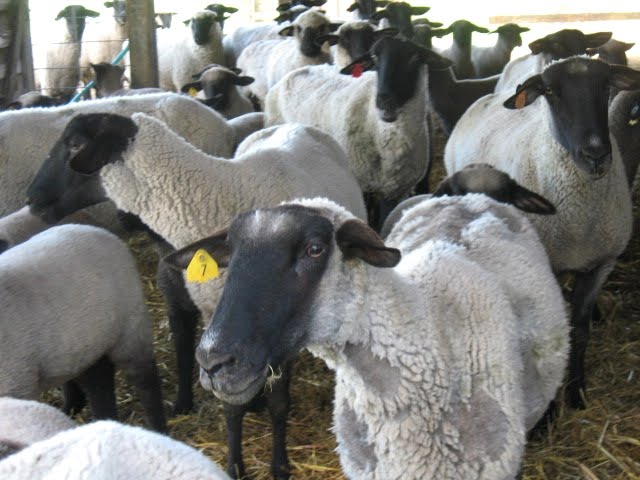


Feeding time at the barn. Notice the lamb in the foreground is loosing his winter coat.


The baby lambs are adorable! This one has blue eyes.


Back in Tom's work space, we talk about his farm and the business of raising lamb.


One of the chefs asked, "Is your meat organic?"

Here is where I learn, consumer ideals don't always line up with the reality of life on the farm. On the Western side of Washington state, our moist climate leads to a number of issues. (We experience 150 days for precipitation/year. Cloudy days: 201; partly cloudy days: 98.) The wet climate leads to a number of challenges, including foot rot.

What is foot rot?

Foot rot, or infectious pododermatitis, is a hoof infection that is commonly found in sheep, goat, and cattle. As the name suggests, it rots away the foot of the animal, more specifically the area between the two toes of the affected animal. It is extremely painful and contagious. It can be treated with a series of medications but if not treated the whole herd can become infected. (Source: Wikipedia)

Tom raises his animals according to organic standards, but because he treats animals that become sick, they are unable to market their lamb as "organic."


Tools of the trade: butchering knives.


Tom's flock, headed out to pasture.


(L-R) The crew: Michelle Clair, Melissa Hogenson, Tracy Smaciarz, Becky Selengut, Tom & his wife, and Chico aka Robert Joice.


Next stop: Heritage Meats. Stay tuned...

3 comments:

Nicholas Barnard said...

Intriguing. So because he uses medications to treat an illness its not organic.

So in theory an organic farm that does treat foot rot is being less compassionate.. Hrm. Its great how we attempt to nicely label everything, but the labels don't always line up with our values.

Its a pretty clear example for knowing your producer...

Amazed said...

As of last fall (Per WSDA Organic program) there are only 2 certified organic sheep/lamb producers in Washington. In speaking with sustainable/natural sheep producers here are the problems:
1. Cannot ever treat with any antibiotics
-- in addition to foot rot, barber pole worm (a nematode) can be a big problem--there are intensive non pharmaceutical methods that can and should be used but Certified organic rules out almost all pharma inputs
2. Certified organic inputs cost ~20% more requiring an additional 20% markup to cover the input cost
3. Even fence posts for perimeter pasture fencing cannot be treated with anything--and require a 1 foot electric fence wire "standoff." Go ahead and price juniper rot resistant posts and seed that they cost 50% more than a standard treated fence post.
4. "Local -- know your producer" is becoming the new organic and is something that the industrial livestock producers cannot capture--through labeling or regulation

Seattle Tall Poppy said...

Nicholas,
Yes, it's quite an eye-opening experience to dig into "What is organic?"

I found this great article: http://www.blackbellysheep.org/articles/organic_lamb.htm
and it outlines points about being an organic rancher in expanded detail. If you bottle feed a lamb, it must be fed organic milk, etc. I'd say another major downside to organic is the massive amount of record keeping required. Does the premium price make up for this? I'm not so sure. And I wonder, how much do consumers really care?

Amazed,
Yowza! I'm so glad you chimed in on this. While I've done a ton of research on this topic, I still wouldn't consider myself an expert. I'm so glad you weighed in here. These are all valid points. While the standards in between commodity and organic vary widely, I am excited to see the rise in CSA's and rapid growth in farmer's markets. Hopefully that will be woven into our culture and not just a food trend.